Governance, Risk, and Compliance — commonly known as GRC — is one of the most accessible, fastest-growing, and surprisingly well-compensated career paths in the entire cybersecurity and technology industry. While penetration testing and software engineering tend to dominate tech career conversations, GRC has quietly become the discipline that every organization desperately needs but consistently struggles to staff. GRC analysts earn a national average of $97,659 per year in the United States, with senior GRC roles pushing well past $160,000 and GRC Managers reaching $150,000–$210,000. And unlike many technical cybersecurity roles, GRC is uniquely accessible to professionals coming from legal, accounting, project management, and business backgrounds — making it one of the best career pivots available in tech today.
This guide walks you through exactly what GRC is, what professionals in the field do day to day, how to break in without a technical degree, and which certifications and career paths will accelerate your trajectory.
What Is GRC and Why Does It Matter?
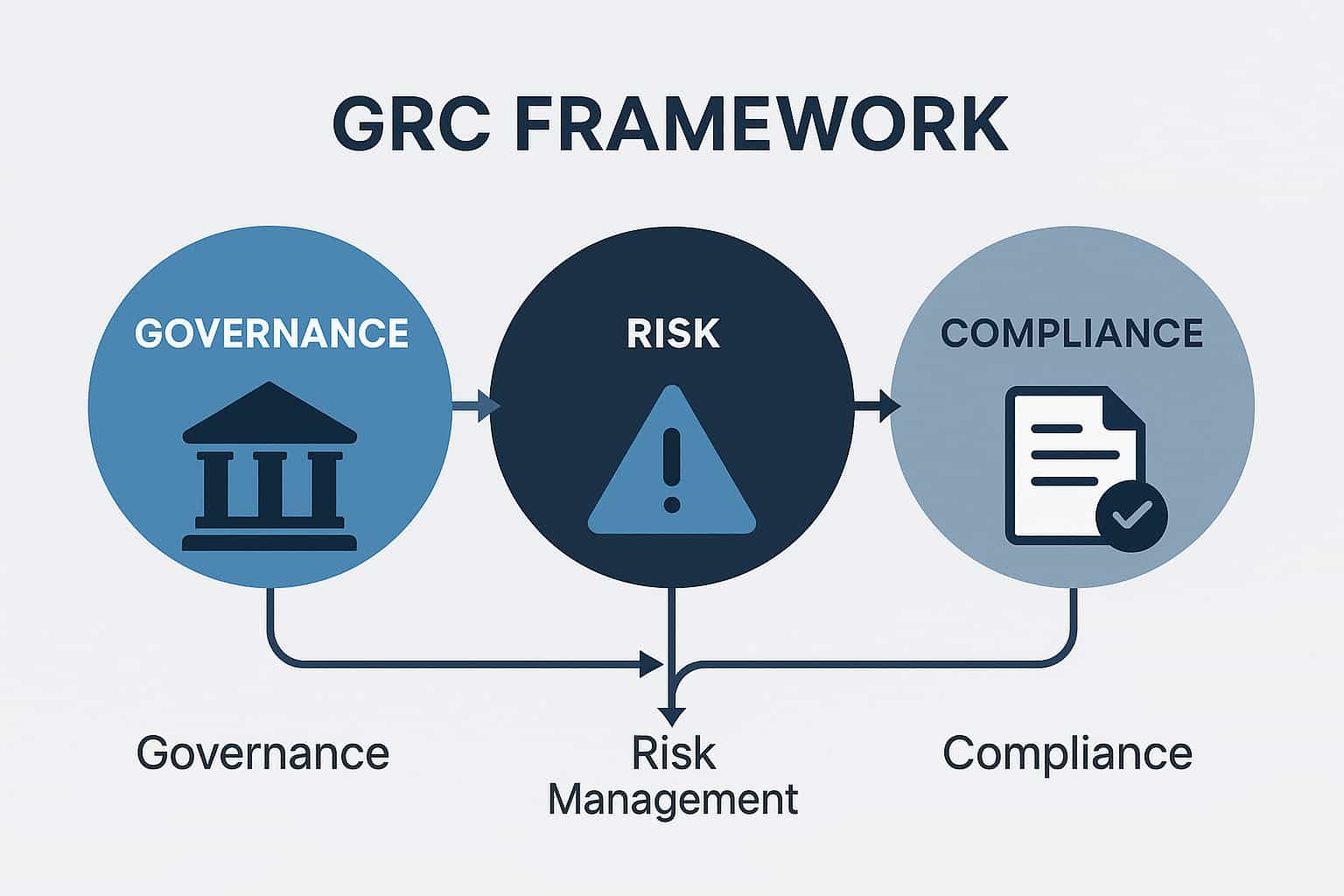
GRC stands for Governance, Risk, and Compliance — three interconnected disciplines that form the backbone of how organizations manage security and regulatory obligations:
- Governance refers to the policies, procedures, frameworks, and accountability structures that guide how an organization manages its information security program. Think of governance as the rulebook that defines how security decisions get made and who is responsible for them.
- Risk involves identifying, assessing, quantifying, and prioritizing threats to organizational assets — from data breaches and ransomware attacks to cloud misconfigurations and third-party vendor vulnerabilities. Risk professionals translate technical threats into business-level financial impact.
- Compliance is the process of ensuring that an organization meets legal, regulatory, and contractual obligations — such as SOC 2, ISO 27001, GDPR, HIPAA, PCI DSS, or the EU AI Act. Compliance professionals ensure the organization is “audit-ready” 365 days a year.
Together, these three functions form the strategic layer of enterprise security. While engineers build and defend systems, GRC professionals define the frameworks, assess the risks, and ensure the organization can prove to regulators, partners, and customers that it is operating securely and responsibly.
Why GRC Is an Exceptional Career Entry Point
GRC offers something rare in the technology industry: a legitimate on-ramp for non-technical professionals. You do not need to know how to write code, configure firewalls, or perform penetration tests to build a successful GRC career. What you do need is the ability to read and interpret regulatory frameworks, write clear policies and procedures, communicate effectively across departments, conduct risk assessments, and think systematically about organizational processes.
This makes GRC ideal for professionals transitioning from:
- Accounting and audit — Audit methodology, evidence standards, and control testing transfer directly
- Legal and paralegal work — Regulatory interpretation and documentation skills apply immediately
- Project management — Coordination, stakeholder management, and timeline tracking are core GRC competencies
- IT support or system administration — Technical understanding strengthens control assessment capability
- Business analysis — Requirements gathering and process documentation are directly applicable
The compliance and risk management landscape grows more complex every year — particularly as AI regulation, cross-border data privacy laws, and cloud security requirements multiply — creating sustained and growing demand for GRC professionals at every level.
Core GRC Roles Explained
GRC Analyst (Entry to Mid-Level)
The GRC Analyst is the workhorse of any compliance program. Day-to-day responsibilities include mapping organizational controls to frameworks like NIST CSF, SOC 2, or ISO 27001; responding to vendor security questionnaires; collecting and organizing audit evidence; writing or updating security policies; and working with engineering and operations teams to close identified security gaps.
Salary range: $60,000–$85,000 entry-level; $85,000–$120,000 mid-level
Compliance Analyst
The Compliance Analyst focuses specifically on regulatory requirements, reviewing SOC reports, interpreting audit findings, and ensuring the organization maintains continuous readiness for external audits. Industry specialization — such as HIPAA for healthcare, PCI DSS for retail, or FINRA for financial services — significantly accelerates career advancement and compensation.
Cyber Risk Manager / Risk Analyst
Cyber Risk Managers evaluate how technical vulnerabilities and security threats translate into financial and operational risk for the business. They produce risk registers, conduct threat modeling, and present risk quantification analyses to executive leadership and boards. The ability to say “we have a vulnerability” isn’t enough — this role demands translating that into “we have an estimated $2.4 million financial exposure”.
Salary range: $110,000–$155,000 at the senior level
GRC Manager and Director
GRC Managers own the compliance program. They design processes, coordinate directly with department heads, manage audit relationships with external firms, and report to the CISO or General Counsel. Directors of GRC set the strategic compliance roadmap and manage a team of analysts.
Salary range: $150,000–$210,000
Virtual CISO (vCISO)
Experienced GRC consultants with broad compliance and risk management expertise often transition into fractional or virtual CISO roles — serving multiple client organizations simultaneously as their outsourced security leadership. The vCISO path represents some of the highest earning potential in GRC, with experienced practitioners billing $200,000–$300,000+ annually. This path is particularly attractive for professionals who prefer consulting independence over corporate employment.
Step-by-Step Roadmap to Break Into GRC
Step 1: Build Security and Compliance Foundations (2–3 Months)
Before pursuing any GRC-specific credential, you need baseline knowledge of security principles. CompTIA Security+ is the single best entry point for anyone moving into GRC from a non-security background — it covers risk management, access controls, cryptography, threat identification, and security program basics that form the vocabulary of GRC work. Pair this with free resources from NIST (the National Institute of Standards and Technology publishes its Cybersecurity Framework and Risk Management Framework publicly at no cost) and ISACA’s Cybersecurity Fundamentals to build framework awareness.
Step 2: Master Compliance Frameworks (3–4 Months)
Deep familiarity with major compliance frameworks is the technical skill of GRC. Prioritize the frameworks most relevant to your target industry:
- SOC 2 — Technology and SaaS companies; the most common framework in U.S. tech
- ISO 27001 — International standard; required by many enterprise clients and global organizations
- NIST CSF — U.S. government and critical infrastructure; increasingly adopted by private sector
- GDPR — European data protection; essential for any company serving EU customers
- HIPAA — U.S. healthcare organizations
- PCI DSS — Any organization that processes payment card data
Free training resources include ISACA’s official framework guides, the NIST website, and SOC 2 Academy. For structured learning, Coursera and SANS both offer compliance-focused training programs.
Step 3: Develop Risk Assessment and Policy Writing Skills (2–3 Months)
Practice building the deliverables that GRC professionals produce every day: risk registers, security policies, audit checklists, vendor assessment questionnaires, and ISO 27001 gap analyses. You can do this entirely on your own by downloading free policy templates, working through NIST RMF documentation exercises, and creating mock risk registers for fictional or real-world organizations. Cloud Security Guy’s substack guide specifically recommends reaching out to small businesses that lack formal security programs and offering to perform a free basic risk assessment — a strategy that builds real portfolio experience while simultaneously providing genuine value to underserved organizations.
Step 4: Learn GRC Platforms and Tools (1–2 Months)
Hands-on familiarity with GRC platforms is increasingly expected even at the entry level. The most widely used tools in the industry are:
- Vanta and Drata — Automated compliance platforms widely used by SaaS startups for SOC 2 and ISO 27001
- ServiceNow GRC — Enterprise-grade GRC management used by large corporations
- RSA Archer — Legacy but still widely deployed in regulated industries
- OneTrust — Privacy compliance and data governance management
Most of these platforms offer free trials or sandbox environments. Getting hands-on experience with at least Vanta or Drata significantly increases your marketability for GRC roles at tech companies.
Step 5: Earn Your First GRC Certification
The right certification depends on your experience level and target role:
Entry-Level:
- CompTIA Security+ — Foundation for all GRC work ($404)
- (ISC)² CC (Certified in Cybersecurity) — Free to obtain, zero experience required; an excellent first credential
Intermediate:
- CISA (Certified Information Systems Auditor) from ISACA — The gold standard for audit and compliance roles; requires 5 years of experience (can be waived partially by education) and costs $760 for members
- CRISC (Certified in Risk and Information Systems Control) from ISACA — Premier risk management credential; targets professionals with 3+ years of experience and costs $760 for members
Cloud-Focused:
- CCAK (Certificate of Cloud Auditing Knowledge) — Now considered essential for cloud-first companies by many GRC hiring managers in 2026
- (ISC)² CGRC (Certified in Governance, Risk, and Compliance) — Particularly valuable for government contractor and federal GRC roles
GRC Career Path Progression
GRC offers two distinct long-term trajectories:
| Track | Progression Path | Peak Compensation |
|---|---|---|
| Risk Management | GRC Analyst → Risk Analyst → Senior Risk Manager → Director of Risk → Chief Risk Officer | $200,000–$300,000+ |
| Compliance | GRC Analyst → Compliance Specialist → Compliance Manager → Director of Compliance → Chief Compliance Officer | $180,000–$280,000+ |
| Executive Security | GRC Analyst → GRC Manager → VP of Security → CISO | $220,000–$420,000+ |
Many CISOs at major corporations come from GRC backgrounds specifically because they understand risk management, regulatory requirements, and how to communicate security priorities to boards and executives — skills that purely technical security professionals often lack.
Industries That Pay the Most for GRC Professionals
Not all GRC roles pay equally. Industries with heavy regulatory requirements pay premiums of 10–20% above the general market:
- Financial services — FINRA, SOX, PCI DSS compliance programs; most aggressive GRC compensation
- Healthcare — HIPAA, HITRUST compliance demands; growing with AI in clinical settings
- Defense and government contracting — FedRAMP, CMMC, NIST RMF; strong demand for cleared GRC professionals
- Critical infrastructure — Energy, utilities, and transportation under NERC CIP and CISA frameworks
- Big Four and boutique consulting — Deloitte, PwC, KPMG, and EY all actively hire GRC consultants at premium rates
Building a GRC Portfolio That Gets You Hired
Hiring managers for GRC roles look for evidence of systematic, detail-oriented thinking and genuine familiarity with compliance frameworks — not coding ability or penetration testing skill. Your portfolio should include:
- A sample risk register with threat identification, likelihood scoring, and mitigation recommendations
- A drafted information security policy (acceptable use, access control, incident response)
- An ISO 27001 or NIST CSF gap assessment applied to a real or fictional organization
- An AI governance assessment demonstrating awareness of emerging AI regulation — one of the most differentiating portfolio items in 2026
- Documented experience with a GRC platform like Vanta, Drata, or ServiceNow (even a free trial)
The compliance and risk management landscape in 2026 is more complex, more globally regulated, and more strategically important than at any point in history. For professionals willing to invest in framework knowledge, certification credentials, and a portfolio of practical GRC deliverables, this career path offers not just competitive salaries and strong job security — but the rare satisfaction of work that makes organizations genuinely safer, more trustworthy, and more resilient.